Choosing the best Lifepo4 Rv Battery in 2026 requires more than comparing capacity labels and attractive prices. RV owners need dependable energy during cold mornings, long off-grid stays, and repeated charging cycles. A 100Ah battery may power a refrigerator overnight, but it may struggle with an inverter, microwave, and heating system together. Real usage matters.
This guide examines battery chemistry, usable capacity, charging speed, low-temperature protection, and battery management systems. It also considers weight, warranty support, installation space, and communication features. These details separate a reliable travel battery from a disappointing purchase. A well-designed battery should deliver stable voltage while running lights, water pumps, fans, and small appliances. It should also protect itself from overcharging, excessive discharge, and unsafe temperatures.
There is no universal winner. That part is easy to overlook. A weekend camper may value low cost and simple installation, while a full-time traveler may need Bluetooth monitoring and expandable storage. Testing methods also have limits, especially when manufacturers provide different performance conditions. Therefore, this comparison combines technical specifications, practical RV experience, and cautious interpretation of customer feedback. Some conclusions may change as new 2026 models appear. That is worth remembering. The best choice depends on your RV’s electrical design, travel habits, climate, and backup expectations. Read beyond the advertised amp hours. Look for honest protection features, realistic warranty terms, and proven support after installation.
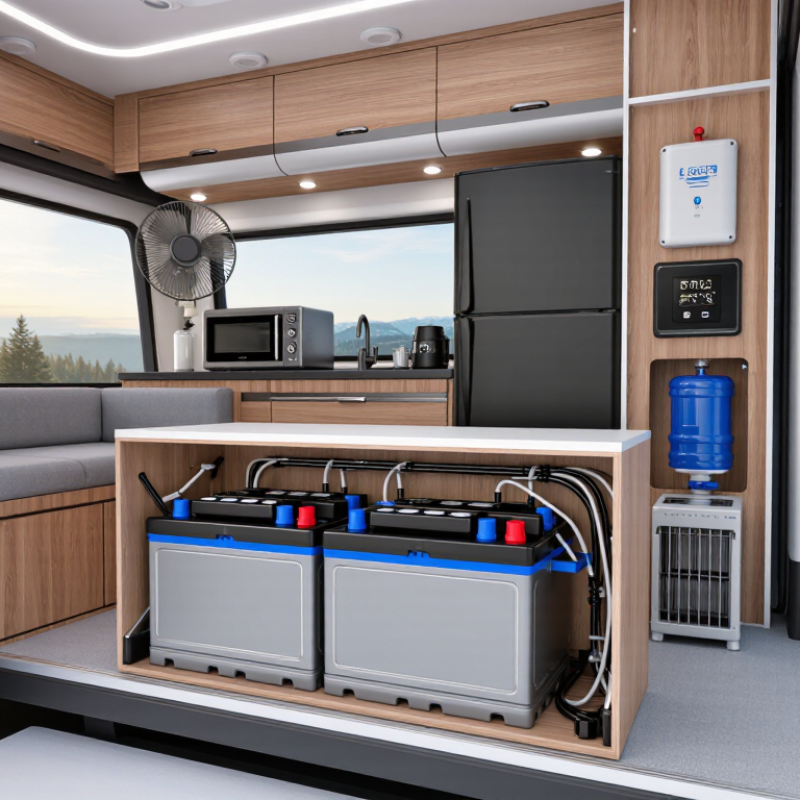
A LiFePO4 RV battery uses lithium iron phosphate as its cathode material. That chemistry stores energy in rechargeable cells, then supplies direct current to lights, a refrigerator, or an inverter. Compared with lead-acid batteries, LiFePO4 packs are generally lighter and can deliver more usable capacity before recharging. That matters when a rig is parked away from hookups and every pound of payload counts. No magic, though: cold temperatures can limit charging, and the battery-management system must protect the cells.
Efficiency is part of the 2026 conversation. The U.S. National Renewable Energy Laboratory’s 2024 Annual Technology Baseline models lithium-ion storage at about 85% round-trip efficiency in grid applications; that is not an RV-specific test, but it illustrates why less stored energy is lost during a charge-and-discharge cycle. For an RV, check the battery’s usable watt-hours, continuous discharge rating, low-temperature charging protection, and compatibility with the charger. A large capacity number can mislead if the inverter draws more current than the battery can safely provide. Installation details matter, too. A well-sized battery still needs secure mounting, suitable wiring, and ventilation for surrounding equipment. A little frustrating, but real: the best choice depends on your loads and travel habits, not just chemistry.
A LiFePO₄ RV battery is a lithium iron phosphate battery designed to store power for an RV’s appliances and electrical system. The best choice depends on your power needs, battery capacity, cold-weather charging protection, BMS limits, and compatibility with your RV’s charging equipment.
For illustration, this comparison uses 12.8 V and an 80% usable-capacity assumption for LiFePO₄, and 12 V and a 50% assumption for lead-acid. Actual usable energy varies with battery specifications, temperature, age, discharge rate, and system losses.
What Is the Best LiFePO4 RV Battery in 2026?
Key Features to Evaluate in a LiFePO4 RV Battery
Compare usable energy, not just amp-hours. A 12.8-volt, 100-Ah battery stores about 1.28 kWh nominally, before conversion losses and operating limits. Match that figure to real loads: a fridge cycling overnight, lights, and a brief inverter surge. A high advertised capacity can still disappoint. Check continuous and peak discharge ratings against your inverter, and confirm that the battery management system protects against overcurrent, overtemperature, and low-temperature charging.
Temperature protection matters in an unheated storage bay. Ask whether charging is blocked below the maker’s stated limit, and whether the battery can safely deliver power in cold conditions. Check terminal type, dimensions, weight, and whether the charger profile suits lithium iron phosphate chemistry. Small fit details matter. The U.S. Department of Energy’s 2022 Energy Storage Technology and Cost Characterization Report uses about 85% round-trip efficiency for lithium-ion storage; this is a grid-scale reference, not a guaranteed RV result. The International Energy Agency’s Global EV Outlook 2024 reports that LFP made up nearly 40% of the global electric-car battery market in 2023. That signals broad adoption, but it does not prove a particular RV battery’s quality. Read the warranty’s cycle and capacity terms, then check independent test data where available. I would still leave a margin for cold nights and aging.
Compare usable capacity, not just amp-hours. A 12.8-volt battery rated at 100 amp-hours stores about 1,280 watt-hours before system losses. Your actual needs depend on the fridge, lights, water pump, and overnight heating controls. Check the manufacturer’s usable-energy rating, then leave a reserve for cloudy days or longer stops. Numbers can mislead. A larger battery is not automatically the better fit.
Power and safety matter just as much. Check continuous and peak discharge ratings against appliances that start suddenly, such as an inverter or compressor. Confirm the battery includes a properly rated battery management system, with protections for overcurrent and temperature. Also verify its charging limits match your converter, solar controller, and expected climate. Cold charging can damage many LiFePO4 cells, so review the specified low-temperature limits. I would not choose by cycle-life claims alone; test conditions vary, and real service life depends on charging habits, heat, and depth of discharge.
Tips: List each device’s watts and daily hours, then estimate watt-hours. Compare that estimate with usable capacity, not the headline rating. Check warranty terms and installation dimensions, too. A careful fit beats a flashy specification.
What Is the Best LiFePO4 RV Battery in 2026?
Which LiFePO4 RV Battery Best Fits Different Travel Needs?
The best LiFePO4 RV battery depends on how you travel, not just its advertised capacity. For weekend trips, a compact 100Ah battery can run lights, phones, a router, and a small refrigerator. It also saves space under a seat. For longer stays, two 100Ah batteries may provide steadier power for an inverter, medical equipment, or cooking appliances.
Check the battery’s continuous discharge rating carefully. A high-capacity battery may still struggle with a coffee maker or microwave. The battery management system should protect against overcharging, deep discharge, overheating, and short circuits. Cold-weather travelers need a low-temperature charging cutoff or built-in heating. Charging frozen cells can cause permanent damage.
Weight matters on small trailers. A lighter battery can improve storage and reduce tongue weight, but only when its case and terminals remain secure. For frequent solar camping, choose a battery that matches your solar controller and charging profile. For winter travel, prioritize temperature protection over maximum amp hours. I have found that real-world performance often differs from product charts. Cable length, poor ventilation, and an underrated inverter can reduce usable power. No battery is perfect. Review independent test data, installation guidance, warranty terms, and service support before choosing.
Choosing the best LiFePO4 RV battery in 2026 depends on installation quality, not only capacity. A 100Ah battery stores about 1.28kWh at 12.8 volts. Allowing for conversion losses, it can support lights, a refrigerator, and small electronics overnight. NREL’s 2024 energy-storage analysis places lithium-ion round-trip efficiency near 85–95%, depending on system design. RV wiring, inverters, and temperature can reduce real-world results.
Install the battery in a dry, ventilated compartment with firm restraint. Use correctly sized cables, fuses, and disconnects near the positive terminal. Follow NFPA 1192 guidance and the battery maker’s current limits. Charging below freezing can permanently damage cells, so a low-temperature cutoff is essential. A practical charging profile usually holds absorption voltage near 14.2–14.6 volts, but the specified value matters more than internet advice.
During long-term use, avoid storing the battery at full charge for months. Around 40–60% state of charge is gentler for storage, with periodic inspection for terminal looseness, swelling, or unusual heat. The U.S. Department of Energy reports that lithium-ion costs and performance continue improving, yet field conditions remain unpredictable. I once trusted a battery monitor without checking its calibration. That was a mistake. Measure resting voltage, review charging history, and leave some reserve capacity for cold nights.
| Evaluation Area | Typical LiFePO4 RV Battery Data | Recommended Selection or Setup | Important Practical Notes |
|---|---|---|---|
| Nominal system voltage | 12.8 V for a four-cell lithium iron phosphate battery; approximately 13.2 V average operating voltage. | Choose a 12.8 V battery for most 12 V RV electrical systems. Use a 25.6 V battery only when the RV is designed for a 24 V system. | Do not connect a 12.8 V battery directly to a 24 V system without a suitable system design and protection equipment. |
| Common capacity options | 100 Ah ≈ 1.28 kWh; 200 Ah ≈ 2.56 kWh; 300 Ah ≈ 3.84 kWh at nominal voltage. | 100 Ah suits light loads and short stays; 200 Ah is a practical general-purpose size; 300 Ah or more is suitable for larger inverter and off-grid loads. | Usable energy depends on the battery management system, discharge limit, temperature, wiring, and inverter efficiency. |
| Usable energy target | Approximately 80–95% of rated capacity may be usable when the battery manufacturer permits that depth of discharge. | Plan daily energy consumption around an 80% depth of discharge for a balance between capacity and service life. | Avoid sizing the battery so that normal use regularly reaches the low-voltage cutoff. |
| Cycle-life expectation | Many quality LiFePO4 cells are rated for approximately 2,000–5,000 cycles under specified test conditions. | Compare the cycle rating at a stated depth of discharge, temperature, and end-of-life capacity rather than relying on cycle count alone. | Actual service life is affected by heat, charging voltage, storage state of charge, discharge current, and charging habits. |
| Battery management system | A built-in BMS normally provides overcharge, over-discharge, over-current, short-circuit, and temperature protection. | Select a BMS with continuous current capacity higher than the expected sustained load and with low-temperature charge protection. | A BMS is not a substitute for correctly sized fuses, disconnects, cables, chargers, and an appropriate enclosure. |
| Continuous discharge current | Common ratings range from approximately 100 A to 200 A for 100–200 Ah batteries, but ratings vary by design. | Calculate current from the largest continuous load and inverter efficiency. A 1,000 W load may draw roughly 85–95 A from a 12.8 V battery. | Brief surge ratings should be checked separately for motor starts, compressors, and inverter startup loads. |
| Charging voltage | Typical 12.8 V LiFePO4 charging voltages are approximately 14.0–14.6 V, depending on the battery manufacturer and charger profile. | Use a charger, solar controller, and DC-to-DC charger specifically configured for LiFePO4 chemistry. | Follow the battery manual because recommended absorption duration, float settings, and charge limits differ between battery designs. |
| Charging current | A common conservative charging rate is 0.2C–0.5C; for a 100 Ah battery, this equals approximately 20–50 A. | Use the lower end for cooler operation and longer charging time; use higher current only when approved by the battery specifications. | The combined output of shore power, solar, alternator charging, and other chargers must remain within the battery and BMS limits. |
| Low-temperature charging | Charging below 0°C can permanently damage many LiFePO4 cells unless the battery has approved heating or charge-inhibit protection. | Use a low-temperature cutoff, internal heater, insulated battery compartment, or temperature-controlled charging arrangement. | Discharging is generally possible below 0°C at reduced performance, but the specific operating range must be confirmed in the manual. |
| Operating temperature | Many batteries specify discharge operation roughly from -20°C to 55°C and charging operation from 0°C to 45°C. | Install the battery away from engine heat, exhaust components, direct weather exposure, and unventilated hot compartments. | Always use the exact temperature limits supplied for the selected battery and its BMS. |
| Installation position | LiFePO4 batteries are generally non-spillable and can often be installed in several orientations, subject to the enclosure design. | Mount upright when possible, secure against vibration, protect terminals from accidental contact, and leave access for inspection. | Do not place the battery in a sealed space that can overheat or where water intrusion is possible. |
| Cable and fuse planning | Cable size depends on current, cable length, allowable voltage drop, insulation rating, and installation conditions. | Install a properly rated fuse or circuit breaker close to the positive battery terminal and size cables for the maximum possible current. | High-current inverter circuits require especially careful protection and secure, low-resistance connections. |
| Solar and alternator integration | Solar charge controllers should use a lithium charging profile; vehicle alternators may require a DC-to-DC charger. | Use a DC-to-DC charger when the alternator, vehicle wiring, or battery management system is not designed for direct lithium charging. | Confirm that all charging sources are coordinated and that low-temperature charging is disabled when necessary. |
| Storage procedure | A partial state of charge is generally preferable for extended storage; many manufacturers recommend roughly 40–60%. | Disconnect unnecessary loads, store in a cool and dry location, and check voltage or state of charge periodically. | Do not leave the battery continuously connected to a charger unless the manufacturer specifically permits that operating mode. |
| Maintenance requirements | LiFePO4 batteries require no water filling or electrolyte equalization. | Inspect terminals, cable lugs, mounting hardware, fuse holders, and the enclosure at least once or twice per year. | Keep terminals clean and dry, tighten connections according to the specified torque, and investigate swelling, heat, odor, or repeated BMS shutdowns. |
| Monitoring features | Optional monitoring may include voltage, current, state of charge, temperature, cycle count, and alarm history. | Choose monitoring that can be read without opening the battery compartment, especially for large off-grid systems. | State-of-charge readings are more useful when the battery monitor is correctly configured and synchronized. |
| Best overall selection criteria | Correct capacity, verified cell quality, suitable BMS protection, clear temperature limits, compatible charging profile, and adequate warranty documentation. | Prioritize system compatibility and safety documentation over the lowest purchase price or the highest advertised capacity. | The best RV battery is the one that matches the RV's loads, charging sources, climate, installation space, and expected travel pattern. |
Note: Ratings and operating limits vary by battery design. Always follow the selected battery, charger, inverter, vehicle, and RV electrical-system manuals.
A 12.8-volt, 100Ah battery stores about 1,280 watt-hours before losses. List each appliance’s watts and daily hours. A refrigerator, lights, and water pump may need less than expected. Leave reserve capacity for cloudy days and aging. Numbers can mislead.
Compare usable watt-hours, not only advertised amp-hours. Conversion losses and operating limits reduce real output. A 100Ah battery may not deliver its full nominal capacity. Check the stated usable-energy rating. I would keep extra capacity for cold nights.
Match continuous discharge power with your inverter and appliances. Microwaves, coffee makers, and compressors can demand sudden power. Check peak discharge ratings for startup surges. A large battery may still struggle. That detail is easy to miss.
Look for a battery management system with overcurrent protection. It should also protect against overcharging, overheating, deep discharge, and short circuits. Confirm the protection ratings match your electrical system. A vague specification deserves caution.
Many LiFePO4 cells should not charge below their specified temperature limit. Charging frozen cells can cause permanent damage. Choose a low-temperature charging cutoff or built-in heating. Cold power delivery may still differ from cold charging. Read the exact limits.
A compact 100Ah battery may run lights, phones, a router, and a small refrigerator. It can fit beneath a seat and save storage space. Check the inverter before adding cooking appliances. Short trips usually need less reserve.
Two 100Ah batteries can provide steadier power for longer stops. They may support an inverter, cooking appliances, or essential equipment. Confirm wiring, charging limits, and protection settings first. More capacity is not automatically better.
Measure the battery compartment before buying. Check terminal type, cable length, weight, ventilation, and mounting security. Confirm that the charger and solar controller use a suitable charging profile. A poor fit can reduce performance. I sometimes underestimate cable losses.
Choosing the best Lifepo4 Rv Battery in 2026 requires more than simply selecting the largest capacity. This article explains how lithium iron phosphate batteries improve RV travel through lighter weight, longer service life, stable power delivery, and enhanced safety compared with older battery types. It examines essential features such as usable capacity, continuous and peak output, built-in protection, temperature performance, charging compatibility, monitoring options, and warranty expectations. Readers will also learn how to compare batteries based on daily energy needs, appliance demands, travel frequency, and available installation space.
The guide matches different battery capacities and power levels to weekend trips, extended off-grid camping, and high-demand RV lifestyles. It also covers practical considerations for installation, proper charging, cold-weather operation, routine maintenance, ventilation, cable sizing, and long-term storage. By evaluating performance, safety, durability, and total ownership needs together, RV owners can choose a dependable Lifepo4 Rv Battery that supports comfortable, efficient, and worry-free travel in 2026.

Grenergy