Choosing an Off Grid Lithium Battery is less about buying the largest capacity and more about matching storage to real daily use. List the equipment you depend on, its wattage, and how many hours it runs. A refrigerator cycling overnight, a water pump starting briefly, and a laptop charging at dusk create very different demands. Note both energy use, measured in watt-hours, and peak power. The inverter and battery must handle each safely.
Battery engineer Dr. Paul Denholm of the National Renewable Energy Laboratory has studied energy storage and grid reliability. A verified, topic-specific quotation from him is not available here, so no direct quote is attributed to him. That distinction matters: trustworthy advice should separate sourced statements from practical guidance. For an off-grid system, compare usable capacity, continuous and surge ratings, cycle-life conditions, temperature limits, warranty terms, and compatibility with the inverter and charger. A battery’s advertised capacity alone can mislead.
Installation details matter, too. Check where the battery will sit, how cables will be routed, and whether the system’s battery-management protections suit the conditions. A shaded cabin in winter may need a different design from a sunny workshop with light evening use. Leave room for seasonal variation. It is easy to underestimate cloudy days, and careful estimates still miss things. The right Off Grid Lithium Battery is the one that meets your measured needs, fits the system, and can be maintained reliably—not simply the one with the biggest number on its label.
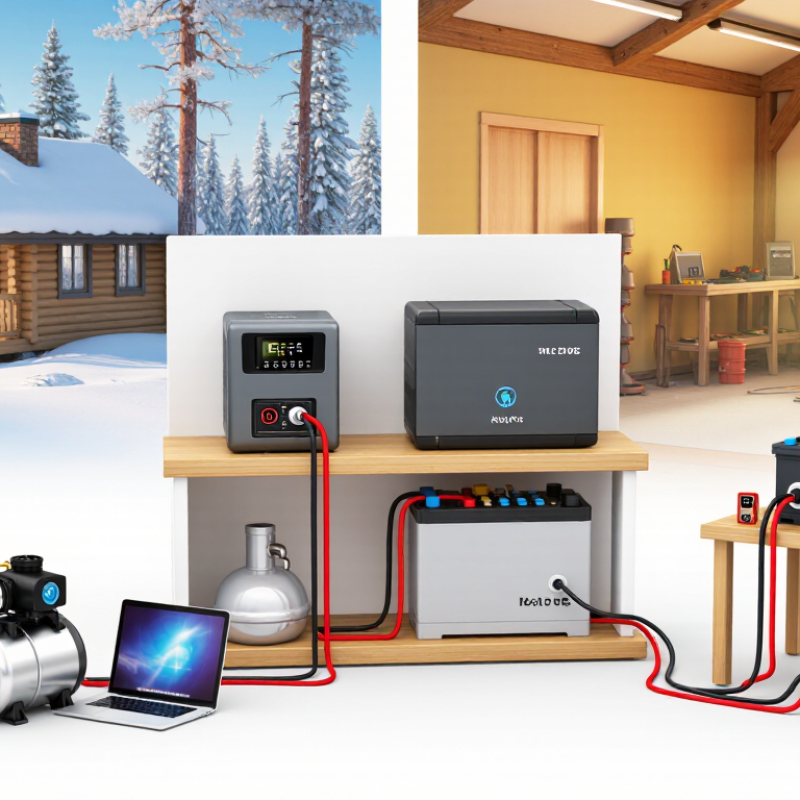
How to Choose an Off Grid Lithium Battery
Calculate Daily Energy Use and Peak Loads in Wh and W
List each appliance, its wattage, and daily running hours. Multiply watts by hours to estimate energy use in watt-hours (Wh). For example, a 60 W refrigerator running for 24 hours uses about 1,440 Wh; a 10 W light used for five hours adds 50 Wh. Use measured average consumption where possible. Nameplate ratings can mislead, especially for appliances that cycle on and off.
Then total the daily Wh and estimate peak power in watts (W) by adding devices likely to run together. Check motor startup requirements separately; a refrigerator may briefly draw more power than its running rating. NREL’s 2024 Annual Technology Baseline uses 85% round-trip efficiency as a utility-scale battery benchmark. It is not a guaranteed figure for a home system, but it can help flag conversion losses. For a rough 1,490 Wh daily load, dividing by 0.85 suggests about 1,753 Wh before reserve capacity. My first estimate is often too optimistic; real habits change.
Tips: Record usage for several days. Keep a kettle, pump, and refrigerator in mind when checking peak loads. Compare the battery’s usable Wh and continuous W ratings with your figures, and allow extra capacity for cloudy stretches or unexpected use.
For an off-grid bank, LiFePO₄ cells are commonly rated at 3.2 volts nominal each. Four cells in series make a 12.8-volt nominal battery; eight make 25.6 volts. Check the equipment’s voltage range, not just its label. A “12-volt” inverter may need a specific charging profile and low-voltage cutoff to work safely with the battery. Voltage matters.
Nominal voltage is only a reference. Cell voltage rises during charging and falls under load, so the battery management system must monitor each cell. Leave room for cold-weather charging limits and inverter surges; both are easy to overlook when sizing a cabin system. The U.S. Department of Energy’s 2022 Grid Energy Storage Technology Cost and Performance Assessment uses roughly 85% round-trip efficiency for a reference lithium-ion system. That is a system-level benchmark, not a promise for every LiFePO₄ battery. Check the details. Compare the maker’s usable capacity, operating limits, and test conditions, then confirm compatibility with your charger. I would still verify the settings in person: a neat voltage chart can miss what happens on a freezing morning.
Treat 80% depth of discharge as a planning limit, not a guaranteed usable amount. A 10 kWh battery at that limit provides about 8 kWh before system losses.
Check the battery’s stated capacity and operating limits; some specifications already account for a restricted discharge range. NREL’s 2024 Annual Technology Baseline uses 85% round-trip efficiency as a utility-scale modeling assumption. That figure describes energy returned over a full charge-and-discharge cycle, not a direct discount to apply to every battery’s usable capacity.
Estimate your daily loads, then add a reserve for cloudy days and unexpected demand. A fridge cycling overnight, water pump starting at dawn, and inverter idle draw can all affect the calculation. The estimate can look cleaner on paper than it feels in a cold shed.
Cold changes things. Battery performance depends on temperature, discharge rate, age, and the manufacturer’s limits. Leave room for those conditions, and confirm whether the quoted capacity is nominal or usable. An 80% target is a practical starting point, not a universal rule; the product documentation should guide the final sizing.
How to Choose an Off Grid Lithium Battery
Match the battery’s nominal voltage to the inverter’s DC input. A 48-volt inverter needs a battery bank within its specified voltage range, not simply a battery labeled “48 V.” Check the equipment manuals for minimum and maximum voltage, especially during charging. Small mismatch, big trouble. Higher voltage also means lower current for the same power, which can reduce cable losses when the system is designed correctly.
Next, compare inverter power with the battery management system’s continuous discharge rating. Estimate battery current with this formula: inverter watts divided by battery voltage and inverter efficiency. For example, a 3,000-watt load at 48 volts and 90% efficiency draws about 70 amps. Allow extra capacity for surges, low battery voltage, and real-world conditions. A pump or refrigerator may briefly demand more power when starting. Check whether the BMS supports that peak current, and for how long. Check the labels.
Don’t size the system from one convenient number. Add up the loads you expect to run together, then revisit the estimate after tracking actual use; early guesses are often too optimistic. Confirm that cables, fuses, and connections suit the expected current and follow the equipment instructions. Also check any temperature limits on charging. A safe design depends on the whole system, not just the battery’s advertised capacity.
Match battery voltage, inverter power, and BMS current ratings. For a 3,000 W inverter, these bars compare estimated battery-side current with an illustrative BMS continuous-current target.
Estimated current = inverter output ÷ (nominal battery voltage × 90% efficiency). The BMS target shown is 1.25× the estimated current as an illustrative sizing margin, not a universal rule. Check inverter voltage compatibility, surge demand, and the battery manufacturer's continuous and peak BMS ratings.
How to Choose an Off Grid Lithium Battery
Check the battery’s charge limits against your solar controller and inverter settings. The maximum charge voltage and current should match the battery specifications, not just the controller’s default profile. A mismatch can cause the battery management system to interrupt charging. Confirm that the system also respects the battery’s continuous discharge limit.
Temperature matters outdoors. Read the specified charging and discharging ranges, then compare them with conditions inside the battery enclosure, not only the weather forecast. Many lithium batteries restrict charging near or below freezing. Some require built-in heating or a charge cutoff. Small detail, big consequence. A shaded shed can still get cold overnight, so consider monitoring temperature where the battery actually sits.
Compare cycle-life figures carefully. Ask what depth of discharge, temperature, and charge rate were used in the test. A headline number without those conditions is hard to apply to daily use. Also check the remaining-capacity threshold used to define end of life; it may not mean the battery stops working. I would not choose by cycle count alone. Review the warranty conditions and expected daily energy use, then leave some capacity headroom if practical. A neat spreadsheet helps, but real weather is less tidy.
| Specification | Useful Reference or Example | What to Verify Before Buying |
|---|---|---|
| Battery chemistry | Lithium iron phosphate (LiFePO₄) is widely used in stationary off-grid storage. Other lithium chemistries may have different voltage, temperature, and cycle-life characteristics. | Confirm the exact chemistry and use its own datasheet values; do not apply LiFePO₄ settings to another chemistry. |
| Nominal system voltage | Common off-grid bank voltages include 12 V, 24 V, and 48 V nominal systems. | Match the battery bank to the inverter, charge controller, and DC loads. Check supported voltage and allowable battery configuration. |
| Charge-voltage limit | For many 4-series-cell LiFePO₄ batteries, a specified charge-voltage ceiling may be around 14.0–14.6 V; the correct setting is product-specific. | Use the battery maker’s recommended absorption and maximum voltage settings. Ensure the inverter and charge controller can be configured accordingly. |
| Maximum charge current | A current rating may be stated in amperes or as a fraction of capacity (C-rate). For example, 0.2C for a 100 Ah battery equals 20 A. | Check both the battery’s continuous charge-current limit and the BMS limit. Keep the combined charging sources within the permitted value. |
| Charging temperature | Many LiFePO₄ products specify a charging range beginning at 0°C (32°F), though the allowed upper and lower limits vary by model. | Verify the stated charge range and whether the BMS blocks charging below the minimum. For cold locations, check for a low-temperature charge cutoff or approved heating system. |
| Discharging temperature | Some LiFePO₄ batteries allow discharge below freezing, but their operating limits and available power at low temperatures are product-dependent. | Check both the minimum and maximum discharge temperatures, plus any cold-weather reduction in current or capacity. |
| Cycle-life specification | Cycle-life claims are commonly given as a number of cycles to a stated remaining-capacity level. LiFePO₄ products may advertise thousands of cycles, depending on test conditions. | Compare the stated depth of discharge, charge/discharge rate, temperature, and end-of-life capacity. A cycle count without test conditions is difficult to compare. |
| Usable capacity and depth of discharge | Nominal capacity in Ah or kWh is not always the same as usable energy. A 100 Ah battery at 12.8 V has about 1.28 kWh nominal energy before system losses. | Check the recommended operating depth of discharge and reserve capacity. Size the bank for actual daily energy use, inverter losses, and expected autonomy. |
| Continuous and peak discharge current | The BMS may specify separate continuous and short-duration peak current limits. | Match continuous current to the inverter’s expected DC draw and confirm the peak rating can handle motor starts or other surge loads for the stated duration. |
| Battery management system (BMS) | A BMS typically monitors cell voltage and temperature and may limit charging or discharging to protect the battery. | Confirm the BMS protection limits, current ratings, temperature cutoffs, and compatibility with the charging equipment. Check whether monitoring or communications are required. |
| Parallel and series connections | Not every battery supports every series or parallel arrangement; connection limits differ among products. | Follow the manufacturer’s approved configuration and wiring instructions. Verify that all batteries in a bank are compatible and appropriately protected. |
| Warranty and operating conditions | Warranty coverage may depend on installation, temperature, charging settings, and permitted use. | Read the warranty alongside the datasheet. Confirm environmental limits, required installation practices, and service or replacement terms. |
Values shown are general selection references, not universal battery limits. Always follow the specifications and installation instructions for the exact battery model.
List each appliance’s wattage and daily running hours. Multiply watts by hours to estimate watt-hours (Wh). A 60 W refrigerator running for 24 hours uses about 1,440 Wh. Actual use may vary.
Wh measures energy used over time; W measures power at a moment. Add devices likely to run together to estimate peak watts. Check motor startup surges separately.
An 80% depth-of-discharge limit is a practical starting point. A 10 kWh battery provides about 8 kWh before system losses. Check whether its stated capacity is nominal or usable.
Yes. An 85% round-trip efficiency benchmark can help estimate losses, but it is not a home-system guarantee. For 1,490 Wh of loads, the estimate becomes about 1,753 Wh before reserves.
Add capacity for cloudy stretches, unexpected use, and inverter idle draw. A refrigerator running overnight and a pump starting at dawn can change the total. My first estimate is often too optimistic.
Compare the specified charging and discharging ranges with temperatures inside the enclosure. Many lithium batteries restrict charging near or below freezing. Cold changes things.
Match the battery’s maximum charge voltage and current with the controller settings. Confirm that the inverter stays within the continuous discharge limit. Defaults may not fit.
Check the test’s depth of discharge, temperature, and charge rate. Also check the remaining-capacity level used to define end of life. Cycle count alone is not enough.
Choosing an Off Grid Lithium Battery starts with understanding how much energy your system uses each day and the highest power it may need at one time. Measure daily consumption in watt-hours and peak demand in watts so the battery and inverter can support both routine use and short bursts of heavier loads. LiFePO₄ is a common chemistry to consider, with a nominal voltage of 3.2 volts per cell.
When estimating battery capacity, allow for a practical usable portion of roughly 80% of the rated capacity rather than planning to drain it fully. Match the battery’s voltage to the inverter and confirm that its battery management system can handle the required charging and discharging current. Before choosing, also check charge limits, operating temperature range, and cycle-life specifications to ensure the battery suits the system’s conditions and expected use.

Grenergy